
Calling on CBA to stop financing deforestation
In brief
We've filed a shareholder resolution with Commonwealth Bank, asking it to set out a clear path toward deforestation-free lending. This is active ownership in practice: your money being used as a tool for real accountability.
Why this matters
Whether you're Australia's largest bank, a shareholder or an individual with a super account, every action and every dollar carries weight. Deforestation drives climate change, strips biodiversity, and puts ecosystems we all depend on at risk, making this as much about your future as it is about corporate policy.
For 40 years, we've been backing the good and avoiding the harmful. But investing ethically isn't always straightforward. There are companies in our portfolio that we believe could do better, and rather than walk away, we work with them. That's the approach we took when we first started engaging Australian banks on fossil fuel financing, and it's the same approach we're applying now to ending livestock-driven deforestation.
What we're asking CBA
Alongside the Australian Conservation Foundation (ACF) and ethical share trading platform, SIX, we put forward a shareholder resolution with the support of people just like you1 asking CBA to commit to a clear pathway toward ending lending that supports deforestation.
Because we hold shares in CBA on your behalf, we have the right to put formal proposals directly to the company's board at their AGM and we encouraged other shareholders to vote in favour of our resolution. We're not asking the bank to cease agricultural lending, we're simply asking the bank to disclose a plan for achieving deforestation-free lending.
CBA has publicly committed to supporting Australia's transition to net zero by 20502. Meanwhile, the Intergovernmental Panel on Climate Change (IPCC) has stated that halting commodity-driven deforestation is essential to reaching net zero3. We don’t think connecting those two things is a stretch! As Australia's largest bank by market capitalisation, CBA has the opportunity to lead on this, but has made a conscious decision not to4.
We attended CBA’s AGM on 15 October, and posed questions to the board, holding them to account on the disconnect between their public commitments and their action. The shareholder resolution we co-filed was supported by 15.56% of shareholders, representing an estimated $20 billion5 worth of CBA's shareholding.
Over the course of our engagement with CBA, we have seen a positive evolution in their acknowledgement of the issue and their response. We think this shows the shareholder resolution strategy is working. At the AGM, the Chair indicated that CBA is prepared to continue to evolve their understanding and potentially their approach. We intend to continue to encourage them to adopt stronger lending restrictions to protect Australia’s unique natural forests.
What the data shows
The ACF's latest Financed Deforestation Report makes the scale of the problem hard to ignore.
The report identifies 82 cases and a total of 16,540 hectares of deforestation linked to major Australian banks through agricultural mortgages. CBA is the second most exposed lender behind NAB. One NSW property linked to CBA saw an estimated 2,506 hectares cleared over four years. That's an area equivalent to almost nine Sydney CBDs. The cleared land included habitat for the endangered pink cockatoo.
In 43 of those 82 cases, koala habitat was cleared, according to the ACF research. Koalas are a protected species under Australian environmental law.
Roughly 44 per cent of Queensland's land clearing is thought to take place in the Great Barrier Reef catchment area. Clearing in that region sends sediment and toxic agricultural runoff directly into the reef, smothering coral and threatening one of Australia's most ecologically and economically significant natural assets.
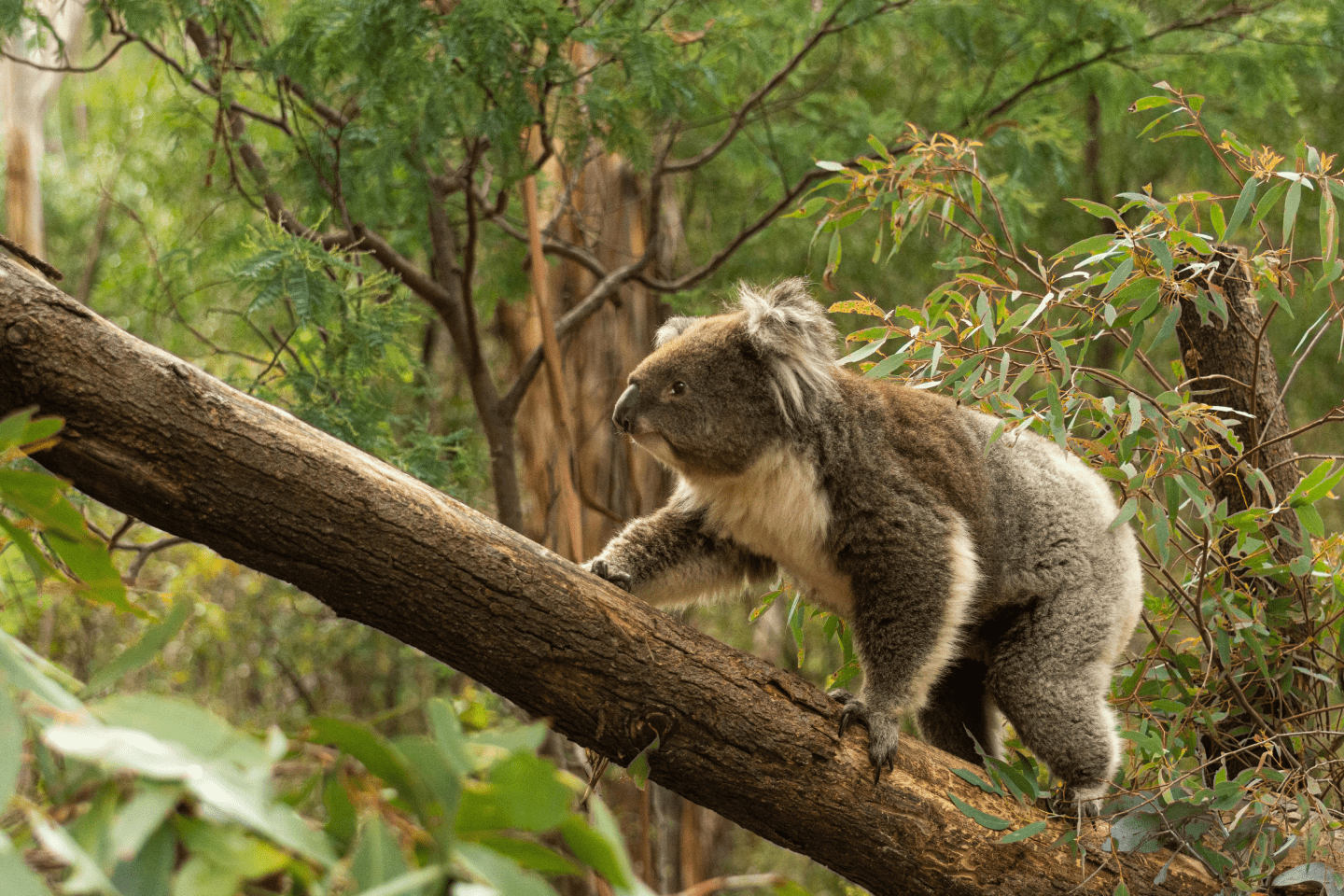
An Australian Conservation Foundation report links major banks to deforestation through agricultural mortgages, with protected species including koalas and pink cockatoos losing habitat as a result.
Where are the other big investors?
We're not engaging with CBA because its deforestation exposure is about to damage its balance sheet. We're engaging because deforestation is a driver of systemic risk to the climate, to ecosystems, and to the broader economy that all of us live and invest in.
Other institutional investors might look at a company's direct financial exposure and, if it looks small in the context of their overall balance sheet, move on. We don't. We ask a different question: what are the biggest drivers of climate change and nature loss, and where are the leverage points to stop them?
We see banks like CBA as leverage points. Stopping the flow of finance to harmful activities is how we work towards outcomes at a scale individual action would find it difficult to reach.
Part of a strategy
This resolution is one part of a body of work we've been building across many years. Earlier this year we invited members to join us in holding QBE to account for underwriting fossil fuel projects. We showed up at the Macquarie AGM in August. The Principles for Responsible Investment (PRI) recognise our approach to sustained strategic engagement, and sustained strategic engagement moves things.
On deforestation specifically, Australian banks and supermarkets have already taken positive steps to address clearing linked to beef supply chains, an issue that was largely unacknowledged amongst Australian investors and corporates when we first raised it. We focus on banks and retailers like Woolworths and Coles because they sit at critical leverage points in the food system. Through both, we can influence land-use outcomes at a scale that wouldn’t be possible otherwise.
Our goal is to disincentivise further clearing and encourage land-use practices that work with nature rather than against it. We complement our direct engagement with companies by working alongside NGOs to keep these issues on the broader investment agenda.
What we're working towards
We want CBA, and other banks, to look more carefully at the activities they finance and to reduce support for operators who treat Australia's unique forests, woodlands and ecosystems as expendable rather than as something worth protecting.
No one wins if deforestation continues. Businesses, economies and our food system depend on healthy natural systems, and we think the financial institutions helping to fund land clearing have both the leverage and the responsibility to be part of the solution.
Many of you have participated in shareholder resolutions and followed our progress along the way. That collective voice is part of what gives this work its weight.
1 Marianne Cannon, a Queensland shareholder featured in this news article is one of more than 200 people who put their shareholding to work supporting this resolution, asking CBA to strengthen its responsible lending practices. We offered our own members the chance to do the same, as we did ahead of the QBE AGM in February this year.
2 Zeroing in: Climate change case studies - Commonwealth Bank of Australia
3 Intergovernmental Panel on Climate Change (IPCC), Climate Change and Land: An IPCC Special Report, 2019, Chapter 4, Executive Summary. The IPCC identifies deforestation as a major contributor to climate change through greenhouse-gas emissions and the reduction of land carbon sinks, and states that failure to address land degradation is inconsistent with the emissions reductions required to limit warming to 1.5°C or 2°C.
4 CBA notes on p21 of its Notice of Annual Meeting as a case against adopting the resolution that institution wide ‘deforestation free finance’ outcome sought by the resolution is not widely adopted across major banks. https://www.commbank.com.au/content/dam/commbank-assets/investors/2026/CBA-2026-Notice-of-Annual-General-Meeting.pdf
5 Estimate calculated using the number of shares voted times the value of CBA shares - reflecting that close to half of all possible votes were cast.


